
Understand the idea.
Across, then up
An ordered pair records a point as . On these positive grids, the first coordinate tells how far across to go from the origin, and the second tells how far up.
Read the axis labels rather than assuming one square is one unit. To read a point, trace vertically to the horizontal axis for , then horizontally to the vertical axis for . Write across first.
Points on an axis
A zero coordinate still gives useful information. At there is no horizontal movement, so the point stays on the -axis. At there is no upward movement, so it lies on the -axis.
The order fixes the roles of the numbers. Swapping to usually changes the location, because the horizontal and vertical distances are exchanged. Keep the brackets and comma to show one ordered pair.
See the method in action.
Read a point
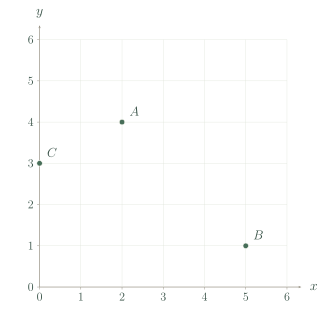
Read A on the supplied grid.
Worked solution
- 1
Read the horizontal position of A.
Following its vertical grid line to the x-axis gives the across coordinate.
- 2
Read its vertical position.
Following its horizontal grid line to the y-axis gives the height coordinate.
- 3
Write the ordered pair.
The horizontal value is written first and the vertical value second.
A is (2, 4).
Plot an axis point
Where should (4, 0) be drawn?
Worked solution
- 1
Follow the first coordinate.
Move four units across from the origin along the horizontal axis.
- 2
Follow the second coordinate.
Zero height means there is no upward movement from the axis.
- 3
Mark the resulting point.
The point lies at 4 on the x-axis, not four units up the y-axis.
On the x-axis at 4.
Try it yourself.
Check your understanding
What does the zero in (0, 6) tell you?
Show answer & reasoning
The point is on the y-axis.
In , means there is no horizontal displacement from the origin. The height is 6, so the point lies on the y-axis.
Keep practising
6 worksheet questions · 7 marks
Read the questions online
- Read B on the grid.1 mark
- Read C on the grid.1 mark
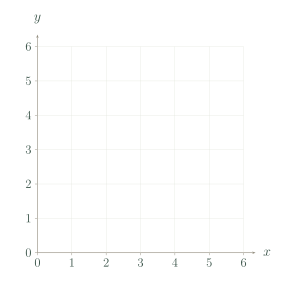
- Plot and label on the supplied grid.1 mark
- Which point lies on the x-axis: , or ?1 mark
- Are and the same point? Explain.2 marks
- A point is 2 units above the origin and has x-coordinate 5. Write its coordinates.1 mark
Read the worked solutions
Equivalent correct methods earn the corresponding marks. Include units where asked.
- Read B on the grid.1 mark
B is 5 across and 1 up.
- Read C on the grid.1 mark
C is on the y-axis at height 3.
- Plot and label on the supplied grid.1 mark
Use first and second.
P at the intersection 3 across and 5 up.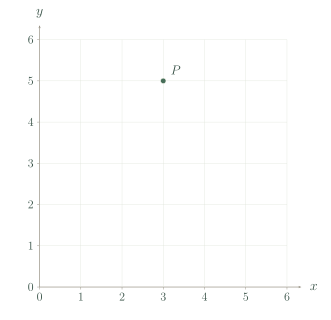
- Which point lies on the x-axis: , or ?1 mark
A point on the x-axis has .
- Are and the same point? Explain.2 marks
Swapping coordinate roles changes the location.
No. One is 1 across and 6 up; the other is 6 across and 1 up. - A point is 2 units above the origin and has x-coordinate 5. Write its coordinates.1 mark
Put the horizontal coordinate first.
Curriculum reference & lesson scope
Australian Curriculum v9 / SA Curriculum Mathematics 2026
Constructing grids; ordered coordinates; movement; translations/reflections/rotations; symmetry.
Official curriculum source ↗