
Understand the idea.
A mirror line matches the whole shape
A line of symmetry reflects an entire shape onto itself. Matching parts lie at equal perpendicular distances on opposite sides of the line. Equal areas on two sides are insufficient if corresponding points do not match.
A square has four symmetry lines: two joining opposite side midpoints and two diagonals. A rectangle that is not square has only the two midpoint lines; reflecting in a diagonal does not match its unequal side lengths.
Turn the outline onto itself
Rotational symmetry means a turn smaller than a full turn makes the outline coincide with its starting outline. Compare around the shape centre. A square matches after a quarter turn, while a non-square rectangle matches after a half turn.
Test the whole boundary, not just one vertex. For straight-sided shapes, tracking every vertex and the joined sides can establish a match. Reflection and rotation are different tests; passing one does not automatically mean passing the other.
See the method in action.
Test a proposed symmetry line
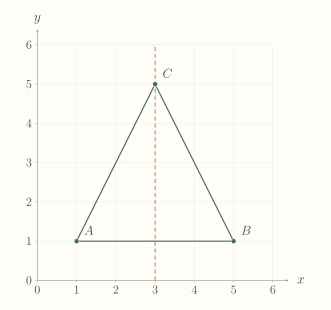
A triangle has vertices A(1,1), B(5,1), C(3,5). Is x = 3 a symmetry line?
Worked solution
- 1
Compare A and B with the proposed mirror.
A and B have the same height and lie two units on opposite sides of x = 3, so they exchange places.
- 2
Check the remaining vertex C.
C has horizontal coordinate 3, so it lies on the mirror line and stays fixed.
- 3
Track the triangle sides.
AB maps onto itself while AC and BC exchange places. All three vertices and their connecting sides match, so x = 3 is a symmetry line.
Yes. The entire triangle reflects onto itself.
Compare two turns
A non-square rectangle matches after a half turn. Must a quarter turn also match?
Worked solution
- 1
Identify what the quarter turn changes.
A quarter turn exchanges the horizontal and vertical side directions of the rectangle.
- 2
Compare the side lengths in those directions.
The long side would need to coincide with a short side. Their unequal lengths prevent a match.
- 3
Compare with the given half turn.
A half turn sends each side to its equal opposite side. That match does not make a quarter turn a symmetry.
No. A half turn matches but a quarter turn does not.
Try it yourself.
Check your understanding
How many lines of symmetry does a square have?
Show answer & reasoning
4
A square has two lines through opposite side midpoints and two diagonals through opposite vertices. These give lines of symmetry.
Keep practising
6 worksheet questions · 9 marks
Read the questions online
- How many lines of symmetry does a non-square rectangle have?1 mark
- Does a square match itself after a quarter turn about its centre?1 mark
- Does a non-square rectangle match itself after a half turn about its centre?1 mark
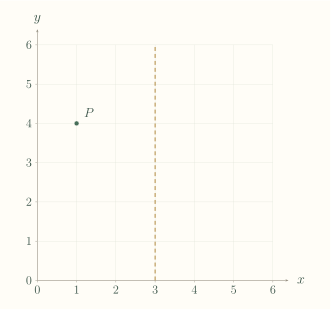
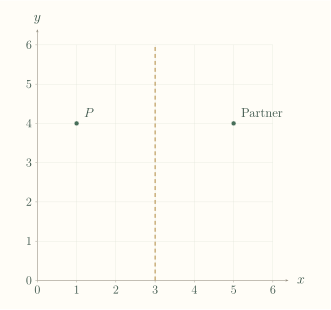
- A shape is symmetric across . One vertex is at . Where is its matching vertex?2 marks
- An isosceles triangle has two equal sloping sides and a different-length base. Describe its one line of symmetry.2 marks
- Leah calls the diagonal of a non-square rectangle a mirror line because it cuts the area in half. Explain the mistake.2 marks
Read the worked solutions
Equivalent correct methods earn the corresponding marks. Include units where asked.
- How many lines of symmetry does a non-square rectangle have?1 mark
The two lines join midpoints of opposite sides and pass through the centre. Diagonals are not symmetry lines.
2 - Does a square match itself after a quarter turn about its centre?1 mark
The four equal sides and four right angles align after each quarter turn.
Yes. - Does a non-square rectangle match itself after a half turn about its centre?1 mark
Opposite corners and equal opposite sides exchange places.
Yes. - A shape is symmetric across . One vertex is at . Where is its matching vertex?2 marks
The first vertex is 2 left of the mirror; its partner is 2 right at the same height.
- An isosceles triangle has two equal sloping sides and a different-length base. Describe its one line of symmetry.2 marks
This line exchanges the equal sides and matches the two base corners.
From the vertex where the equal sides meet to the midpoint of the base, perpendicular to the base. - Leah calls the diagonal of a non-square rectangle a mirror line because it cuts the area in half. Explain the mistake.2 marks
Symmetry requires a matching reflected outline, not merely equal areas.
It gives equal-area triangles, but reflection across it does not match the long and short sides.
Curriculum reference & lesson scope
Australian Curriculum v9 / SA Curriculum Mathematics 2026
Constructing grids; ordered coordinates; movement; translations/reflections/rotations; symmetry.
Official curriculum source ↗