
Understand the idea.
Change the coordinate matching the direction
Horizontal movement changes ; vertical movement changes . Moving right adds to , and moving left subtracts from it. Moving up adds to , and moving down subtracts from it.
Keep the unchanged coordinate visible. From , moving three right gives : the height remains one. For a longer route, record the new ordered pair after each move to avoid changing the wrong number.
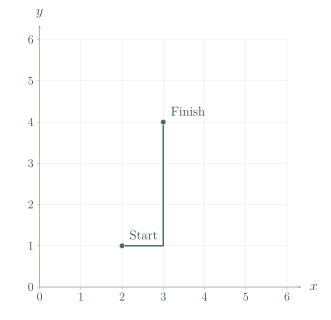
Check a longer route
Check each stop against the grid limits. A valid instruction can lead beyond a small drawn grid, so do not force the endpoint onto the nearest edge. Use the stated units, not just a count of squares.
To undo a route, reverse the order of its moves and change each direction to its opposite. Undoing “right two, then up one” means “down one, then left two”. Grid route lengths follow the horizontal and vertical moves.
See the method in action.
Follow two moves
Start at (1, 2). Move 4 right, then 3 up. Find the endpoint.
Worked solution
- 1
Move four units right.
A rightward move changes only the horizontal coordinate.
- 2
Move three units up.
An upward move changes only the vertical coordinate.
- 3
State the endpoint.
Both instructions have been applied in order to the starting point.
(5, 5)
Work backwards
A robot ends at (4, 3) after moving 2 left and 1 up. Where did it start?
Worked solution
- 1
Undo the last move first.
The last move was up one, so its reverse is down one.
- 2
Undo the earlier left move.
Reversing a move two left requires moving two right.
- 3
Check the original route forwards.
Left two and up one return to the given endpoint, confirming the start.
(6, 2)
Try it yourself.
Check your understanding
Start at (5, 4) and move 3 left. Where do you finish?
Show answer & reasoning
(2, 4)
Moving left subtracts from while keeping fixed. Thus becomes .
Keep practising
6 worksheet questions · 10 marks
Read the questions online
- Start at . Move 2 right. Give the new coordinates.1 mark
- Start at . Move 3 down. Give the new coordinates.1 mark
- Start at . Move right 3, up 4, then left 2. Find the endpoint.2 marks
- Give horizontal and vertical directions from to .2 marks
- A robot moves right 2 and down 3, finishing at . Find its start.2 marks
- Two routes go from to . A goes right 3 then up 2; B goes up 2 then right 3. Compare their lengths along grid lines.2 marks
Read the worked solutions
Equivalent correct methods earn the corresponding marks. Include units where asked.
- Start at . Move 2 right. Give the new coordinates.1 mark
x becomes ; y stays 3.
- Start at . Move 3 down. Give the new coordinates.1 mark
y becomes ; x stays 4.
- Start at . Move right 3, up 4, then left 2. Find the endpoint.2 marks
.
- Give horizontal and vertical directions from to .2 marks
right; down.
4 right and 3 down, in either order. - A robot moves right 2 and down 3, finishing at . Find its start.2 marks
Undo down 3 by going up 3, then undo right 2 by going left 2.
- Two routes go from to . A goes right 3 then up 2; B goes up 2 then right 3. Compare their lengths along grid lines.2 marks
Each uses 3 horizontal steps and 2 vertical steps: .
Both routes are 5 units long.
Curriculum reference & lesson scope
Australian Curriculum v9 / SA Curriculum Mathematics 2026
Constructing grids; ordered coordinates; movement; translations/reflections/rotations; symmetry.
Official curriculum source ↗