
Understand the idea.
Two number lines meet
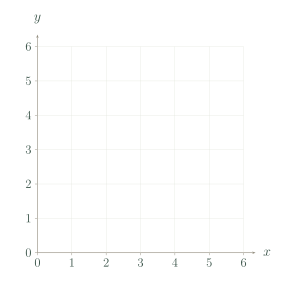
A coordinate grid uses two perpendicular number lines: the horizontal -axis and vertical -axis. They meet at the origin, . Points are located at intersections, rather than inside the square spaces.
Draw straight axes and label them clearly. Choose equal intervals along each axis and show the numbers they represent. A one-unit grid increases by one whenever you cross the next grid line.
Choose and keep a scale
The scale says how much one interval represents. Five squares can show ten metres if each square represents two metres. Labels then increase by two, even though the spaces on the page remain equal.
Keep each axis consistent from start to finish. The two axes can use different scales when needed, but each scale must be clear. Do not change the numerical jump partway along equally spaced marks.
See the method in action.
Construct a small grid
Describe how to make a grid showing coordinates from 0 to 5 in both directions.
Worked solution
- 1
Draw and name the two axes.
The horizontal and vertical axes must be perpendicular so their directions are clear.
- 2
Mark their common origin.
Both axes start their positive measurements at the same intersection.
- 3
Mark five equal one-unit intervals on each.
Five spaces require six boundary marks when zero is included.
- 4
Complete the matching grid lines.
Lines through corresponding marks create intersections covering coordinates from 0 to 5 in both directions.
A grid with named axes, a common origin and equal one-unit intervals from 0 to 5.
Choose a scale
A path reaches 10 metres east. Your grid is five squares wide. What horizontal scale lets it fit exactly?
Worked solution
- 1
Share the required distance among the squares.
All five equal squares must together represent the 10-metre horizontal span.
- 2
Label the horizontal positions.
Each successive grid line adds another two metres.
- 3
Check that the path fits exactly.
The rightmost grid line represents the full required distance.
Each square represents 2 metres; label 0, 2, 4, 6, 8, 10.
Try it yourself.
Check your understanding
An axis is labelled 0, 3, 6, 9 at equal spaces. What comes next?
Show answer & reasoning
12
The labels increase by each interval. After , add the same jump: .
Keep practising
6 worksheet questions · 9 marks
Read the questions online
- Name the horizontal axis on a coordinate grid.1 mark
- Name the point where the axes meet.1 mark
- Draw a first-quadrant grid from 0 to 4 on each axis. Use one square for one unit and label both axes.2 marks
- An axis is labelled 0, 2, 4, __, 8 at equally spaced marks. Fill the gap.1 mark
- You have six squares across to show 12 centimetres. Choose a scale and write the seven labels, including zero.2 marks
- A pupil labels consecutive equally spaced marks 0, 1, 2, 5. Explain what needs correcting.2 marks
Read the worked solutions
Equivalent correct methods earn the corresponding marks. Include units where asked.
- Name the horizontal axis on a coordinate grid.1 mark
The horizontal number line is conventionally called x.
The x-axis. - Name the point where the axes meet.1 mark
Both coordinate values are zero where the axes meet.
The origin, . - Draw a first-quadrant grid from 0 to 4 on each axis. Use one square for one unit and label both axes.2 marks
Use a ruler; mark four equal steps from 0 in both directions.
x horizontal, y vertical, common origin, equal one-unit intervals labelled 0 to 4.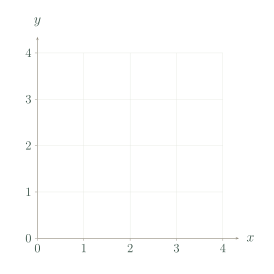
- An axis is labelled 0, 2, 4, __, 8 at equally spaced marks. Fill the gap.1 mark
The scale increases by 2 each time.
6 - You have six squares across to show 12 centimetres. Choose a scale and write the seven labels, including zero.2 marks
; both endpoints are labelled.
2 centimetres per square; 0, 2, 4, 6, 8, 10, 12. - A pupil labels consecutive equally spaced marks 0, 1, 2, 5. Explain what needs correcting.2 marks
The final jump is 3, unlike the earlier jumps of 1.
The labels or positions need equal numerical intervals. For one-unit steps use 0, 1, 2, 3.
Curriculum reference & lesson scope
Australian Curriculum v9 / SA Curriculum Mathematics 2026
Constructing grids; ordered coordinates; movement; translations/reflections/rotations; symmetry.
Official curriculum source ↗