
Understand the idea.
Gradient is change per input unit
Gradient measures output change per unit of input. For two distinct points on a non-vertical line, use . Subtract in the same point order above and below the fraction.
The sign shows direction: positive rises as input increases, negative falls. Units follow the axes, such as dollars per kilometre. A vertical line has zero horizontal change, so this division cannot give a finite gradient.
Intercepts answer different questions
The -intercept is where ; the -intercept is where . In , the intercept value is , and the corresponding point is .
If the equation is not already solved for , rearrange it first, dividing every term when necessary. Interpret either intercept in context only when its input is allowed by the practical domain.
See the method in action.
Recover a line
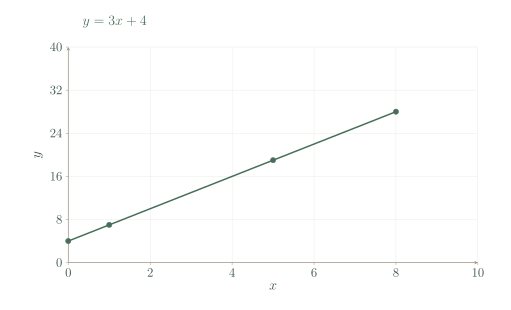
Find gradient and y-intercept for a line through and .
Worked solution
- 1
Find matching coordinate changes.
The output rises twelve while the input rises four.
- 2
Use one point to find the constant.
The point with coordinates one and seven lies on the required line.
- 3
State and verify the line.
The second point also satisfies the rule, whose gradient is three and intercept value four.
Gradient 3; y-intercept 4.
Read both intercepts
Find gradient and intercepts of .
Worked solution
- 1
Isolate the output.
Divide both the constant and the variable term by two.
- 2
Read the gradient and vertical intercept.
The coefficient of the input is the gradient, and the constant is the output at zero.
- 3
Set the output to zero.
A point on the horizontal axis has zero output.
- 4
State the other intercept.
Coordinates are written as input first, then output.
Gradient −2; intercepts and .
Try it yourself.
Check your understanding
Give gradient and y-intercept of .
Show answer & reasoning
Gradient −3; y-intercept 8.
Write . Comparing with gives gradient and -intercept value , at .
Keep practising
6 worksheet questions · 12 marks
Read the questions online
- Find gradient through and .2 marks
- Find gradient through and .2 marks
- Find gradient and -intercept of .2 marks
- Find both intercepts of .2 marks
- A cost graph has gradient 4.5 dollars/km and -intercept 9 dollars. Interpret both.2 marks
- What is the gradient of ?2 marks
Read the worked solutions
Equivalent correct methods earn the corresponding marks. Include units where asked.
- Find gradient through and .2 marks
.
3. - Find gradient through and .2 marks
.
. - Find gradient and -intercept of .2 marks
Rearrange to .
Gradient ; -intercept 12. - Find both intercepts of .2 marks
At , .
At , .
and . - A cost graph has gradient 4.5 dollars/km and -intercept 9 dollars. Interpret both.2 marks
The intercept is cost at zero distance.
The gradient is the charge for one extra kilometre.
A fixed fee of 9 dollars plus 4.50 dollars/km. - What is the gradient of ?2 marks
All points have zero horizontal change.
The ratio would require division by zero.
Undefined; no finite gradient.
Curriculum reference & lesson scope
SACE Board of South Australia
Stage 1 General Mathematics: algebraic and graphical modelling of linear/exponential change, with interpretation and evaluation.
Official curriculum source ↗