
Understand the idea.
One picture for one response
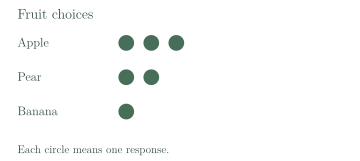
A picture display uses symbols to show counts. Read the key before counting: here one circle means one response. The three circles beside Apple therefore show three children choosing apple, just as a table count of would.
The title tells you what information was collected. The row labels tell you which choice each row shows. The key tells you how to read its symbols. Use all three so you know what you are counting.
Make comparisons fair
Draw equal-sized symbols with even spaces, and line up the starts of the rows. You can then match symbols across rows to compare counts. Stretching the spaces would make a row look longer without adding any responses.
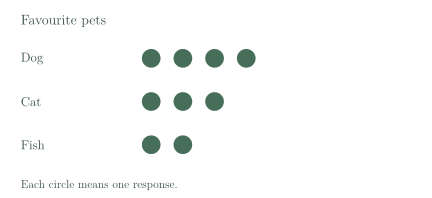
For the pet choices, draw four symbols for Dog, three for Cat and two for Fish. Count the symbols in each labelled row back against the recorded numbers. One symbol must keep the same meaning throughout the display.
See the method in action.
Read a picture row
How many children chose pear?
Worked solution
- 1
Find the row labelled Pear.
The label connects the circles in that row to the fruit asked about.
- 2
Read the key and count the row's circles.
One circle means one response, and the Pear row has two circles.
- 3
Say what the count represents.
Each child gave one fruit choice, so two pear responses mean two children chose pear.
2 children.
Build a block display
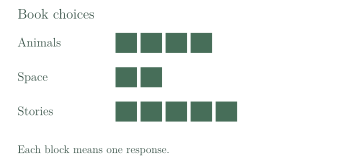
Use one block per choice to show Animals 4, Space 2 and Stories 5.
| Type | Number |
|---|---|
| Animals | 4 |
| Space | 2 |
| Stories | 5 |
Worked solution
- 1
Name the display and label its rows.
The title names the information; the Animals, Space and Stories labels identify the three choices.
- 2
Draw one equal block for each choice.
The rows need four, two and five blocks, starting in line with each other and using equal spacing.
- 3
Add the key and check every row.
Counting the blocks gives Animals four, Space two and Stories five, so every row matches its given count.
The rows have 4, 2 and 5 blocks. The key says one block means one response.
Try it yourself.
Check your understanding
A row has five circles. One circle means one child. How many children does it show?
Show answer & reasoning
5 children.
The key says each circle represents one child. Counting five circles therefore gives five children; no circle is counted twice or left out.
Keep practising
6 worksheet questions
Read the questions online
- How many children chose dog?
- Which fruit has the shortest row?
- Draw a picture display for pencil colours: Red 3, Blue 5, Green 2. Use one equal symbol per pencil.
- One block represents one response. A display has four blocks for Bus, but the table says Bus 2. What should change?
- Name two features that help someone understand a picture display.
- Draw a block display for the vehicle table. Use one block per vehicle and write a key.
Vehicles observed in five minutes. Vehicle Number Car 6 Bus 2 Bicycle 3
Read the worked solutions
- How many children chose dog?
Count four circles in the Dog row.
4 children. - Which fruit has the shortest row?
It has one circle, fewer than the other rows.
Banana. - Draw a picture display for pencil colours: Red 3, Blue 5, Green 2. Use one equal symbol per pencil.
Draw one labelled row for each colour.
Use equal symbols and aligned starts.
Check all three counts.
Red: 3 symbols; Blue: 5; Green: 2. Include a title, labels and key. - One block represents one response. A display has four blocks for Bus, but the table says Bus 2. What should change?
One block means one response.
Four blocks would show four buses.
Remove two blocks, leaving two. - Name two features that help someone understand a picture display.
Accept any two of title, clear row labels, a key, or equal symbols.
For example: a title and a key. - Draw a block display for the vehicle table. Use one block per vehicle and write a key.
Vehicles observed in five minutes. Vehicle Number Car 6 Bus 2 Bicycle 3 Use equal blocks and align the row starts.
Check that the total is 11 blocks.
Car: 6 blocks; Bus: 2; Bicycle: 3. One block means one vehicle.
Curriculum reference & lesson scope
Australian Curriculum v9; SA Curriculum Mathematics 2026
Surveys/observations; lists/tables; creating displays; comparing representations and conclusions.
Official curriculum source ↗