
Understand the idea.
Read across, then up or down
An ordered pair always records horizontal position before vertical position: . To read a point, project it straight down or up to the -axis, then across to the -axis. Keep each coordinate’s sign.
Read the scale before counting grid spaces. Here each interval is one unit; on another grid an interval might represent two or five units. Count units from the origin, not simply the number of lines visible beside a point.
Plot and check
To plot a point, start at . Move horizontally for the first coordinate, then vertically for the second. Mark the intersection clearly and place its letter slightly to one side so the point itself remains visible.
Check a plotted point by reading its coordinates back from the axes. For , the horizontal position must be three right and the vertical position two up. Swapping the coordinates would give a different point, .
See the method in action.
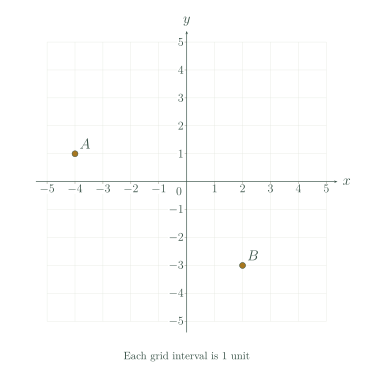
Read point A
Read the coordinates of A on the grid.
Worked solution
- 1
Read A’s horizontal position.
The grid has one-unit intervals, and A is four units left of the origin.
- 2
Read A’s vertical position.
A is one unit above the horizontal axis.
- 3
Write the pair in coordinate order.
Horizontal position comes first, followed by vertical position.
A = (−4,1).
Plot a point
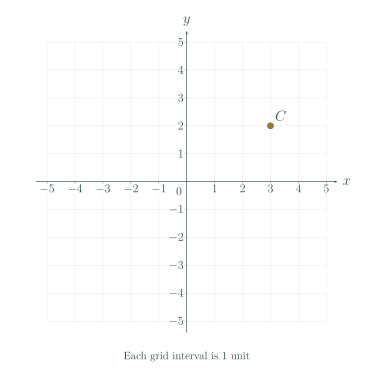
Plot C = (3,2).
Worked solution
- 1
Move horizontally from the origin.
The first coordinate is positive three, so move three units right.
- 2
Move vertically to the requested height.
The second coordinate is positive two, so move two units up without changing the horizontal position.
- 3
Mark and label the intersection.
The labelled point is three units right and two units up from the origin, as required.
C is 3 right and 2 up from the origin.
Try it yourself.
Check your understanding
A point is 2 units left and 4 units up from the origin. Give its coordinates.
Show answer & reasoning
(−2,4)
Two units left gives and four units up gives . Writing horizontal before vertical gives .
Keep practising
6 worksheet questions · 11 marks
Read the questions online
- Read the coordinates of B on the grid.1 mark
- Plot on the grid.2 marks
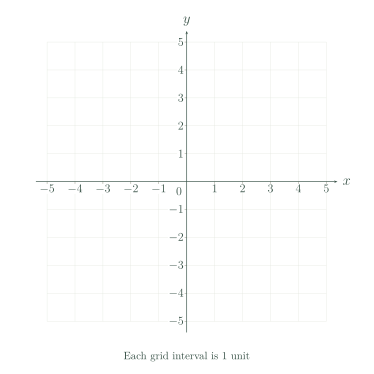
- Plot on the grid.2 marks
- Plot , and . Join P to Q, Q to R and R to P.3 marks
- For , Sam moves 4 units left and 2 units up. Explain and correct the plotting error.2 marks
- Give the coordinates of a point on the -axis 5 units left of the origin.1 mark
Read the worked solutions
Equivalent correct methods earn the corresponding marks. Include units where asked.
- Read the coordinates of B on the grid.1 mark
B is 2 right and 3 down from the origin.
- Plot on the grid.2 marks
Use , then .
P is 2 left and 4 up from the origin.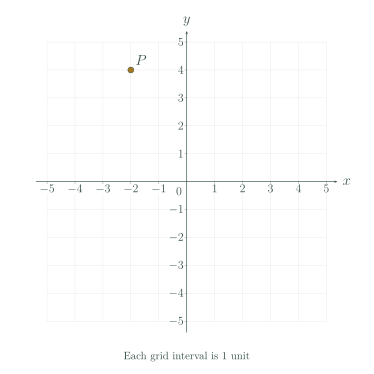
- Plot on the grid.2 marks
Use , then .
Q is 4 right and 1 down from the origin.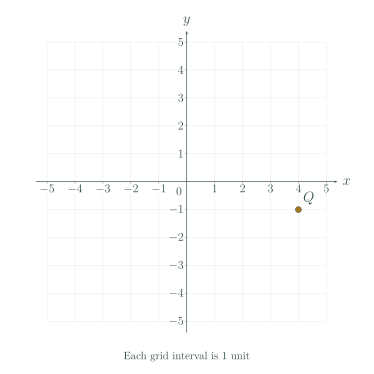
- Plot , and . Join P to Q, Q to R and R to P.3 marks
P and Q share .
Q and R share .
Join the vertices in the stated order.
The three points form a triangle with a horizontal side PQ and a vertical side QR.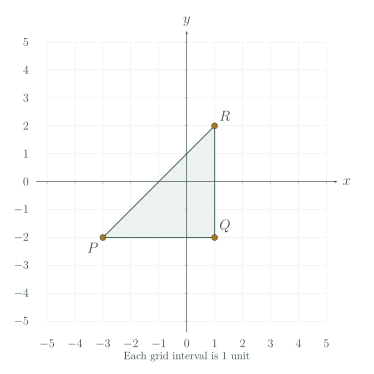
- For , Sam moves 4 units left and 2 units up. Explain and correct the plotting error.2 marks
The first coordinate, 2, is the horizontal move.
The second coordinate, , is the vertical move.
Sam used the wrong direction and swapped the values. Move 2 right and 4 down. - Give the coordinates of a point on the -axis 5 units left of the origin.1 mark
Five left gives .
On the -axis, .
Curriculum reference & lesson scope
Australian Curriculum v9 / SA Curriculum Mathematics
Year 6 four-quadrant Cartesian coordinates, plotting and reading points, and coordinate changes.
Official curriculum source ↗