
Understand the idea.
Change one coordinate at a time
A horizontal slide changes only : moving right adds to it and moving left subtracts from it. A vertical slide changes only : moving up adds to it and moving down subtracts from it. Keep the unchanged coordinate.
A slide may cross an axis, so a coordinate’s sign can change. Starting at and moving five units right gives . Three units reach zero, and the remaining two continue onto the positive side.
Reflect across an axis
A reflection places a point the same distance on the other side of a mirror. In the -axis, horizontal position stays fixed and changes sign: . In the -axis, changes sign: .
A point on the mirror axis stays in place because its distance from the mirror is zero. For a shape, apply the same move to every vertex, then join the corresponding vertices in order. Reflections and slides preserve lengths.
See the method in action.
A slide crossing both axes
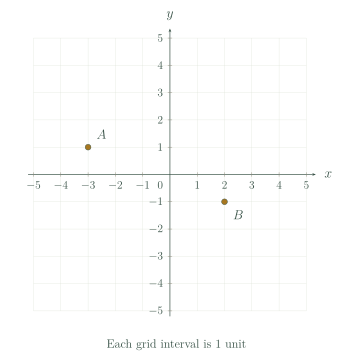
A point starts at (−3,1). Move it 5 units right and 2 units down. Find the result.
Worked solution
- 1
Apply the horizontal slide.
Moving right increases the horizontal coordinate, including when the move crosses zero.
- 2
Apply the vertical slide.
Moving down decreases the vertical coordinate while leaving the new horizontal coordinate unchanged.
- 3
Combine the new coordinates.
The final point is at horizontal position two and vertical position negative one.
(2,−1).
Two reflections
Reflect (−4,3) in the x-axis, then reflect the result in the y-axis.
Worked solution
- 1
Reflect the original point in the horizontal axis.
Reflection in the x-axis reverses vertical position but keeps horizontal position.
- 2
Reflect that image in the vertical axis.
Reflection in the y-axis reverses the new horizontal position but keeps its vertical position.
- 3
Check the final signs.
The first reflection changes only the original y sign; the second changes only its x sign.
(4,−3).
Try it yourself.
Check your understanding
Reflect (−2,5) in the y-axis.
Show answer & reasoning
(2,5)
Reflection in the -axis changes the horizontal coordinate from to and keeps the height . The image is .
Keep practising
6 worksheet questions · 11 marks
Read the questions online
- Move 1 unit left and 5 units up.2 marks
- Move 2 units right and 3 units up.2 marks
- Reflect in the -axis.1 mark
- Reflect in the -axis.1 mark
- Describe one horizontal move and one vertical move taking to .2 marks
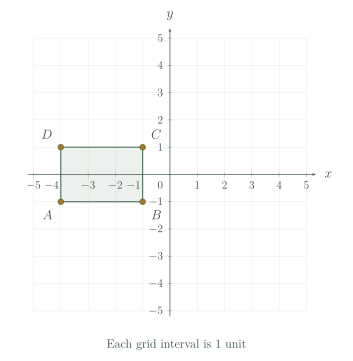
- A rectangle has vertices , , , . Slide it 3 units right and 2 units up. Plot the image.3 marks
Read the worked solutions
Equivalent correct methods earn the corresponding marks. Include units where asked.
- Move 1 unit left and 5 units up.2 marks
; .
- Move 2 units right and 3 units up.2 marks
; .
- Reflect in the -axis.1 mark
Keep and reverse the sign of .
- Reflect in the -axis.1 mark
Reverse the sign of and keep .
- Describe one horizontal move and one vertical move taking to .2 marks
Horizontal change: .
Vertical change: .
5 units right and 3 units up. - A rectangle has vertices , , , . Slide it 3 units right and 2 units up. Plot the image.3 marks
Add 3 to every -coordinate.
Add 2 to every -coordinate.
Reconnect the points in the same order.
New vertices: , , , .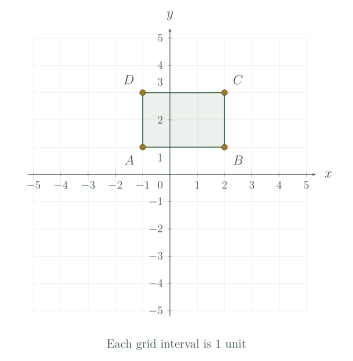
Curriculum reference & lesson scope
Australian Curriculum v9 / SA Curriculum Mathematics
Year 6 four-quadrant Cartesian coordinates, plotting and reading points, and coordinate changes.
Official curriculum source ↗