
Understand the idea.
Two directions from the origin
The horizontal -axis and vertical -axis meet at the origin, . An ordered pair gives horizontal position first and vertical position second. Positive values mean right or up; negative values mean left or down.
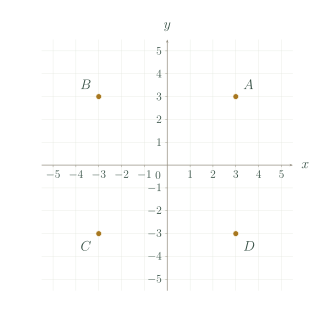
The axes divide the plane into four quadrants. Start with Quadrant I in the top right and count anticlockwise. The sign pairs are I: , II: , III: and IV: .
Points on an axis
Check for a zero coordinate before choosing a quadrant. If , the point lies on the -axis. If , it lies on the -axis. Points on an axis are boundaries between quadrants, rather than inside one.
The origin lies on both axes. A point such as is below the origin on the -axis: the zero horizontal coordinate keeps it on that axis, even though its vertical coordinate is negative.
See the method in action.
Read the signs
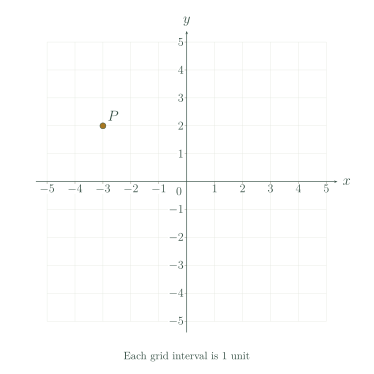
Which quadrant contains (−3,2)?
Worked solution
- 1
Read the horizontal coordinate.
A negative horizontal coordinate places the point left of the vertical axis.
- 2
Read the vertical coordinate.
A positive vertical coordinate places the point above the horizontal axis.
- 3
Name the region.
Left and above is the top-left quadrant, numbered II.
Quadrant II.
A point on a boundary
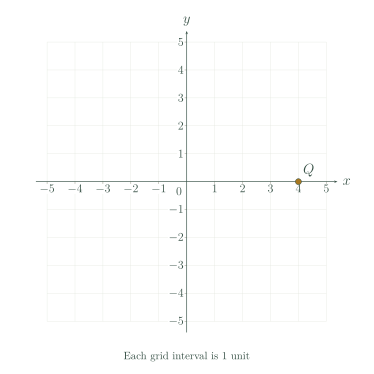
Locate (4,0). Is it in Quadrant I or IV?
Worked solution
- 1
Move to the horizontal position.
The point is four units right of the origin.
- 2
Inspect the vertical coordinate.
There is no movement above or below the horizontal axis.
- 3
Classify the location.
An axis is a boundary, so this point belongs to neither Quadrant I nor Quadrant IV.
It is on the x-axis, in neither quadrant.
Try it yourself.
Check your understanding
Which quadrant contains (2,−5)?
Show answer & reasoning
Quadrant IV
For , positive means right and negative means down. That is the bottom-right region, Quadrant IV.
Keep practising
6 worksheet questions · 8 marks
Read the questions online
- Name the quadrant containing .1 mark
- Name the quadrant containing .1 mark
- Name the quadrant containing .1 mark
- Name the quadrant containing .1 mark
- Describe the location of . State whether it lies in a quadrant.2 marks
- Leo says is in Quadrant III because it is to the left. Explain the error.2 marks
Read the worked solutions
Equivalent correct methods earn the corresponding marks. Include units where asked.
- Name the quadrant containing .1 mark
Both coordinates are positive: right and up.
Quadrant I - Name the quadrant containing .1 mark
Negative and positive mean left and up.
Quadrant II - Name the quadrant containing .1 mark
Both coordinates are negative: left and down.
Quadrant III - Name the quadrant containing .1 mark
Positive and negative mean right and down.
Quadrant IV - Describe the location of . State whether it lies in a quadrant.2 marks
places the point on the -axis.
On the -axis, 2 units below the origin; no quadrant. - Leo says is in Quadrant III because it is to the left. Explain the error.2 marks
The -coordinate is zero, so the point is on a boundary.
Quadrant III requires both and to be negative.
It is on the -axis, not in Quadrant III.
Curriculum reference & lesson scope
Australian Curriculum v9 / SA Curriculum Mathematics
Year 6 four-quadrant Cartesian coordinates, plotting and reading points, and coordinate changes.
Official curriculum source ↗