
Understand the idea.
Move one step at a time
A translation slides every point the same distance and direction. A reflection flips points across a fixed mirror line. A rotation turns points about a fixed centre through a stated angle and direction. These transformations preserve the shape’s lengths and angles.
For combined moves, record the image after the first instruction. Then use that new position as the starting point for the second instruction. Tracking each vertex in order prevents the two moves from being applied separately to the original shape.
Order can change the result
The order of different moves can change the final position. Sliding and then reflecting will not always give the same image as reflecting and then sliding. Keep a stated mirror line or rotation centre fixed unless the instructions explicitly move it.
For a reflection, check that each point and its image are equally far from the mirror on opposite sides. For a rotation, check distance from the centre. After all moves, the image must retain the original side lengths and angles.
See the method in action.
Slide, then reflect
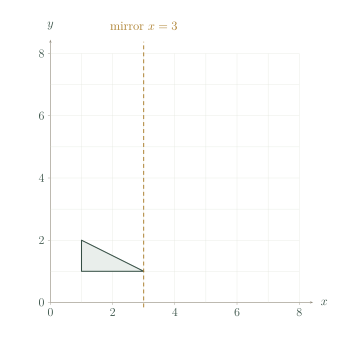
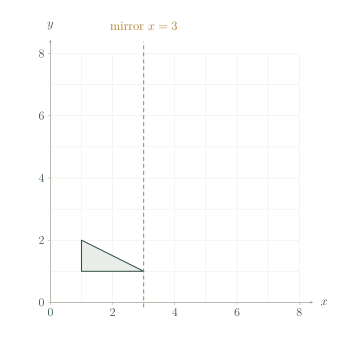
Triangle vertices are (1,1), (3,1) and (1,2). Slide 2 units right and 1 unit up. Then reflect in x = 3. Find the final vertices.
Worked solution
- 1
Slide each vertex right and up.
Adding two to every horizontal coordinate and one to every vertical coordinate gives the translated image.
- 2
Keep the vertices on the mirror fixed.
Both vertices have horizontal coordinate three, so they lie on the mirror line and stay fixed.
- 3
Reflect the vertex away from the mirror.
The translated vertex is two units right of the mirror, so its image is two units left with the same height.
- 4
List the final corresponding vertices.
The reflection acts on the translated triangle, and the original vertex order is retained.
(3,2), (1,2), (3,3)
Turn, then slide
A point is at (5,4). Rotate it 90° anticlockwise about (4,4), then slide 2 units left. Find the final point.
Worked solution
- 1
Locate the point relative to the centre.
The vertical coordinates match and the horizontal coordinates differ by one.
- 2
Make the anticlockwise quarter-turn.
A 90-degree anticlockwise turn takes the rightward direction to upward while preserving the distance from the centre.
- 3
Slide the rotated point two units left.
The second move acts on the rotated image and changes only its horizontal coordinate.
(2,5)
Try it yourself.
Check your understanding
A point (2,1) moves 3 right and 2 up. Where is it?
Show answer & reasoning
(5,3)
A slide of three right and two up changes the coordinates to . Both changes apply to the same starting point.
Keep practising
6 worksheet questions · 13 marks
Read the questions online
- Move point 3 units right and 2 units up. Give its new coordinates.1 mark
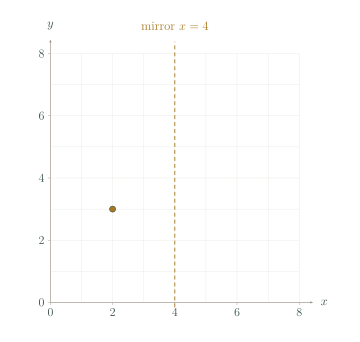
- Reflect point in the vertical line . Give its image.2 marks
- Rotate point anticlockwise about . Give the new point.2 marks
- Triangle vertices are , , . Slide 2 right and 1 up, then reflect in . Plot the final triangle.3 marks
- Start at . Plan A reflects in then slides 2 right and 1 up. Plan B slides first, then reflects in . Find both final points.3 marks
- A triangle is reflected and then rotated. Name two measurements that remain unchanged.2 marks
Read the worked solutions
Equivalent correct methods earn the corresponding marks. Include units where asked.
- Move point 3 units right and 2 units up. Give its new coordinates.1 mark
; .
- Reflect point in the vertical line . Give its image.2 marks
It is 2 units left of , so the image is 2 units right.
The height stays 3.
- Rotate point anticlockwise about . Give the new point.2 marks
A point 1 right of the centre moves to 1 above it.
- Triangle vertices are , , . Slide 2 right and 1 up, then reflect in . Plot the final triangle.3 marks
After sliding: , , .
Reflect across .
Final vertices: , , .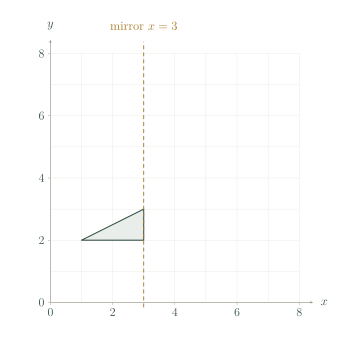
- Start at . Plan A reflects in then slides 2 right and 1 up. Plan B slides first, then reflects in . Find both final points.3 marks
A: reflects to , then moves to .
B: moves to , which lies on the mirror and stays fixed.
A: ; B: . - A triangle is reflected and then rotated. Name two measurements that remain unchanged.2 marks
Both moves preserve size and shape.
Its position or orientation may change.
Its side lengths and angle sizes.
Curriculum reference & lesson scope
Australian Curriculum v9 / SA Curriculum Mathematics
Year 6 prism cross-sections, combined transformations and tessellations, with visual reasoning.
Official curriculum source ↗