
Year 12 General Mathematics math worksheet answers
Year 12 General Mathematics Direction/form/strength of association Worksheet Answers
Read the answers online
direction/form/strength of association
Equivalent correct methods earn the corresponding marks. Include units where asked.
- Describe direction, form and strength for .3 marks
Paired measurements 1 10 2 8 3 6 4 4 Each one-unit rise in reduces by 2.
All points lie exactly on .
Perfect negative linear association. - Describe the supplied pairs .3 marks
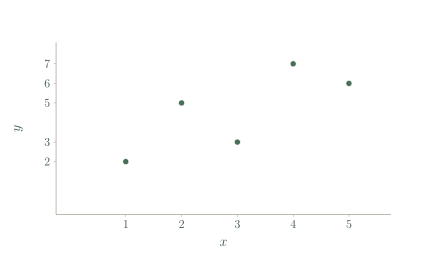
The overall response increases as increases.
It is not exact and no strong curvature is evident.
Positive, roughly linear association with visible scatter. - A scatter plot rises sharply but its points are widely scattered. Is “strong because it is steep” valid?3 marks
Slope and strength describe different features.
Assess closeness to the trend, not just steepness.
No. Wide scatter can indicate weak linear association despite a steep trend. - What form is suggested by ?3 marks
Paired measurements 0 1 1 2 2 4 3 8 Successive -values double.
The increase is not constant, so a straight line is not the natural form.
Positive nonlinear, exponential-looking association. - The U-shaped data have . Is there no relationship?3 marks
The increasing and decreasing sections balance the linear correlation.
Inspect the graph; only summarises a straight-line tendency.
No. There is a strong nonlinear relationship . - Two graphs show the same data but use centimetres and metres on the vertical axes. Should their correlation strengths differ?3 marks
Every vertical value is multiplied by the same positive constant.
The display’s apparent steepness can change while stays the same.
No. A positive unit conversion does not change the association strength.