
Year 11 Specialist Mathematics math worksheet answers
Year 11 Specialist Mathematics Argand diagrams Worksheet Answers
Read the answers online
Argand diagrams
Equivalent correct methods earn the corresponding marks. Include units where asked.
- On an Argand diagram, plot , and . State their coordinates.3 marks
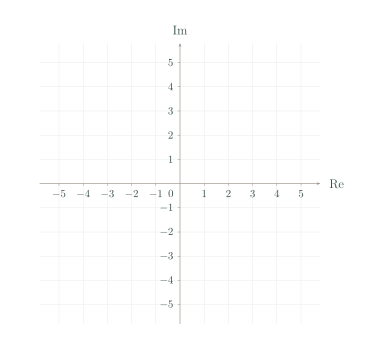
Use the real part for the horizontal coordinate and the imaginary coefficient for the vertical coordinate.
, and . - A point is three units left of the origin and four units below it. Write the complex number.2 marks
Left is negative real; below is negative imaginary.
. - For , state the coordinates of and .3 marks
Conjugation reverses the imaginary coordinate.
Negation reverses both coordinates.
and . - Find the distance from to .3 marks
The horizontal and vertical differences are and .
Distance is .
. - A rectangle has vertices , , and . Find its perimeter and area.3 marks
The side lengths are and .
Perimeter and area .
Perimeter units; area square units. - Describe the transformation that maps every point to .3 marks
If , then .
The horizontal coordinate reverses while the vertical coordinate stays fixed.
Reflection in the imaginary axis.