
Year 10 math worksheet answers
Year 10 Direction/strength/form of association Worksheet Answers
Read the answers online
direction/strength/form of association
Equivalent correct methods earn the corresponding marks. Include units where asked.
- Describe the association for , , , , .2 marks
Every increase of 1 in gives a decrease of 2 in .
All points lie on .
Perfect negative linear association. - Describe , , , , .2 marks
The responses alternate rather than consistently rise or fall.
Five points alone offer limited evidence.
No clear linear direction; the points are scattered. - Can a curved pattern be strong? Give a reason.2 marks
Strength means closeness to a pattern.
Points may lie very close to a curve.
Yes. - A graph changes from metres to centimetres on one axis. Does that alone strengthen the association?2 marks
Only the unit scale changes.
The underlying paired observations and relative pattern are unchanged.
No. - Describe the supplied study-time plot using all three features.2 marks
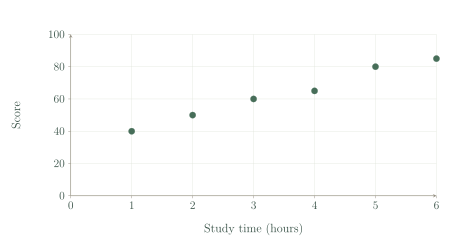
Scores generally rise with study time.
There is some scatter around a roughly straight trend.
Positive, quite strong, approximately linear association. - A single point lies far from the main pattern. State two sensible next steps.2 marks
An unusual point is not automatically wrong.
Report and justify any later exclusion.
Check the recording/measurement and investigate its context.