
Year 10 math worksheet answers
Year 10 A bivariate investigation and its limitations Worksheet Answers
Read the answers online
a bivariate investigation and its limitations
Equivalent correct methods earn the corresponding marks. Include units where asked.
- Write a focused bivariate question about students that uses two numerical variables.2 marks
Specify a population.
Choose two measurable numerical variables.
For example:'Among Year 10 students, is height associated with arm span?' - State a consistent recording plan for height and arm span.2 marks
Use common units and precision.
Keep pairs together.
Measure both in centimetres with the same procedures; record paired values for each participant. - Why might choosing only the basketball team limit a height/arm-span investigation about all Year 10 students?2 marks
Team selection can relate to physical characteristics.
Use a wider sampling frame.
The selected group may not represent the full year. - Describe the supplied revision/score pattern and one limitation.3 marks
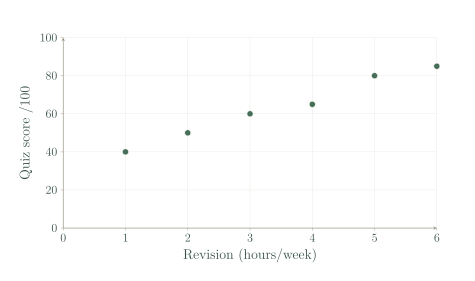
Scores tend to rise with reported revision hours.
Self-reporting and confounding also limit interpretation.
Positive roughly linear association; the small volunteer sample may be unrepresentative. - Give one reason not to predict the score for 20 revision hours from data covering 1–6 hours.2 marks
The relationship may not continue unchanged.
The sample does not support that range.
It is extrapolation far beyond the observed range. - A class finds no clear pattern. Write an honest conclusion and one improvement.3 marks
Do not change or hide data to support the prediction.
Improve a specific limitation rather than promise a different result.
No clear association was found in this sample; collect a larger, fairer sample with more consistent measurements.